

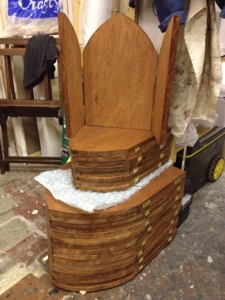
Above are the medium and small pieces each hand built by myself.

I accidentally give myself a stigmata with my screwdriver while working. Rather significant given I am painting saints, don't you think?

I finish at 11pm. The tubes reach their last stops at about 1am so as long as I get on a tube by midnight I will make it home. I step on a double decker bus instead and head for Brick Lane.

Brick Lane is a small winding street that makes its way from Algate East Station to near Liverpool Station. A lot of artists live in this area and it is known for its curries, retro clothing shops and Indian fabric shops. It is heaving with Indian eateries that are still serving people.

A
little further on I hit the night clubs and pub/outdoor grills.

I forge on further down Brick Lane so aptly named after the brick
cobbled streets. For the Olympics someone decided it should be paved
despite protests from all the shop owners. And it was paved.

I reach what I am looking for: the famous 24 hour bagel shop. There is a winding queue inside. The bagels are made fresh in the back.

The place is packed. I get my £1 decadent cream cheese bagel. There is
no need to think about Food Safe here because none is observed
whatsoever. But whatever doesn't kill you makes you stronger, right?

I take a peek in the back where they are making bagels. They all invite me in to chat, take pictures and enthusiastically let me question them about their process. The weekends are their busiest times when they make about 2000 bagels a day. Whatever hour of the night or day I have come to this shop I have had to queue.

The process starts at the big mixer. Unfortunately there is nothing that gives reference in the photo to how big this mixer is. It is unusually wide and shallow and I could comfortably fit in it.


It is then fed into the rolling/donut shaping machine.

You can see the dough going by in a blur. It rolled into a snake by the big metal paddle on the right which is then wrapped around the white round bit on the left to form the donut shape.

They then come out on the other end on a conveyer belt. These are stacked on wooden floured racks.

Next they are dumped into the boiling water and cooked for two minutes.

In the draining sink beside the boiler the long wooden planks are laid out.

The boiled bagels are dumped out onto the boards and briefly hosed down to cool them off slightly or to stop them cooking perhaps.

The boards are then each slid length-wise into the deep oven and left there while the bagels bake on top. I am told this is a traditional Polish/Jewish method.

Once the top is a bit dry and crisp to the touch the boards are flipped over and removed while the bagels are left in the oven browning on the second side. To get all these bagels out a big piece of plywood is slid underneath them and pulled out.

There is a bit of tussle over how to pose for the photo and who is to be holding the tray.

Okay, back up a little bit so I can get you both in.

Perfect. I am fed bagels in the back and given a bag of hot ones fresh out of the oven.

Then each tray is dumped into a big basket between the kitchen and the shop where the women out front cut them and fill them.

And finally the shop.
At this point I look at my watch and it reads 12:15am. I say good bye and walk as fast as my expanding 3-bagel-belly will allow. As I approach the tube I notice a lot of other people walking very quickly there as well. But alas, there is an announcement that the last train has already departed from this station. It is now 12:35am.
It is Night Bus time. London's Tube and day bus routes may shut down at night but you are never stranded. All through the night the night buses run. They run on different routes and times than the day ones. You can get places a lot faster at night on buses. From Trafalgar Square I can take Night Bus N87 all the way to my house in 30 minutes. This route just doesn't exist in the day and it actually takes longer on the tube. The buses seem to directly hook up all the outlying areas with the city centre. The roads are also quieter at this hour.
I have two buses to catch as I am not quite in the city centre. I am standing in East London. The buses and streets are very busy despite the hour. The seats are all taken on the first bus and there are many people standing. London is a 24 hour city.
I make it to my transfer bus depot and get on the N87. Somewhere along the line we pick up a group of inebriated friends. One vomits on the bus and we are all kicked off. All of us! The entire bus. Thankfully another bus comes shortly and I am home at 2:30am. Excellent! Another good day.


