Above is the route we take down fron Hvar Island to Dubrovnik.

We stay in a place in the new town called Guest House Marija, which is a highly rated hostel (individual bedrooms but shared kitchen and bathroom). We are in the off season travelling in September/October so it isn't packed. Marija is a Croatian grandmother that keeps the place so clean you suspect she comes in daily to clean it. She also looks like she is raising her grandchildren as well. A lovely woman who reminds me of my Baba and has a knack for not speaking any English but somehow one understands exactly what she is saying.

The population of Dubrovnik is only 49,000 and sprawls several kilometres along the coast line. But the heart of the city is the old town. The entrance to the old walled city is the Pile Gate, above, where buses from ferries and city buses arrive. It is the most obvious entry point to begin exploring.
This is a map of the old city. (sorry about all this strange spacing that keeps occuring in this blog. It is exasperating and has almost finished my patience off. I am looking at leaving blogger and continuing in another one. Rant done!)
I am looking down from above onto Onofrio's Large Fountain built in 1444. It consists of a circle of heads that spout water and sits just within the Pile gate. Visitors to the city had to wash themselves before they were admitted to guard the city against the plague.
The fountain was built by the Italian architect, Onofrio Della Cava and was part of an elaborate water system that brought water from Mount Srd (above the city) to public washing facilities across town.
This small stone with a gargoyle face sticks out of the wall of the Franciscan Monastary just above the pavement. It is unknown why it has become a feat of male endurance to try to balance on it facing the wall and remove one's shirt without falling off. It is extremely difficult to do.

One "must-see" if you are in Dubrovnik is the War Photo Limited which exhibits some of the world's best photographers. It declares its intentions to "educate the public in the field of war photography, to expose the myth of war and the intoxication of war, to let people see war as it is, raw, venal, frightening, by focussing on how war inflicts injustices on innocents and combatants alike." It is extremely moving and we spend some time there going over the current exhibition by Yuri Kozyrev on his images from this spring of his photos from Egypt to Lybia to Bahrain.

There is a permanent exhibition on the upper floor devoted to the war in Yugoslavia with images from Ron Haviv. The following 3 shots are from this room. Above are recent witnesses during the war of the slaughter

of 50 people.
Above, the siege of Dubrovnik (1991-92). In October 1991 units of the Yugoslav People's Army supported by volunteers from Montenegro and Serb-dominated eastern Hercegovina, overran the tourist resorts south of the city and Mount Srd, the high ground above the city.The bombardment of the city began in early November and lasted until May 1992. Dubrovnik's defences held out in the end and the siege was broken in July 1992 by a Croation offensive from the north. Once the land links to the rest of Croatia was restored the southern points were also liberated.

Here a photo of a funeral of the boy's father who is one of the victim's of the war.

A map of the city posted at the city gates.

The map key.
Also worth visiting is the Memorial Room of the Defenders of Dubrovnik which has a photo of every Dubrovnik who was killed in defending the city. It is housed in the Sponza Palace and is free.

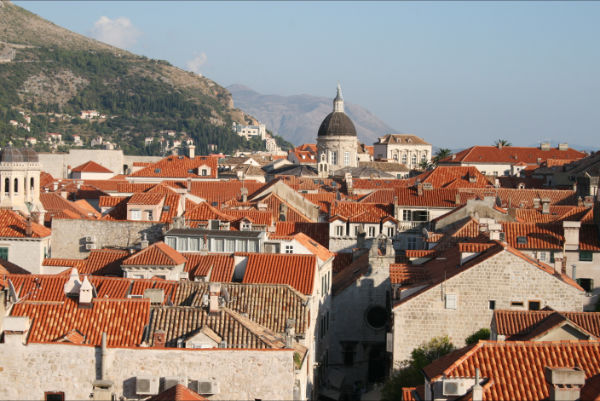
Next we take a tour of the city walls. The entire wall (as old as the 10th century) is walkable and has an amazing view of the old and new city. The following photos are my shots from the 90 minute walk.


It is fun to look over the wall and discover a hidden swimming spot. One has to mark the place we are in the old city to return and find the door that leads to the swimming spot.

This is Onofrio's Little Fountain that is found at the other end of the city at the gate to the marina.
The sun starts to set and we start to think about dinner. If you want to beat the rush at the good places to eat you have to get seated before 7pm.

We have a few favourites up our sleeves.

My favourite is Nishta's (which comes highly recommended by locals and guidebooks). It is the only purely vegetarian place to eat and it does not disappoint a long time vegetarian who likes to cook! We ate there 2 nights in a row.

Next is Nigel's favourite Dubrovnik eatery, The Taj Mahal. Strangely named, as it is traditional Bosnian food, that has a few amazing vegetarian options. It also comes highly recommended and both are reasonably priced. We eat here twice too.

This is my veggie option...roast veg and Bosnian cheese with a garlic olive oil. On the side two slices of savoury pie/struedel.
 We take a day trip 20 kilometres south of Dubrovnik down the coast to the small town of Cavtat.
 Cavtat, called Epidaurus, was founded by a colony of Greeks. It later became a Roman colony around 228 BC. We visit the 7th century town that grew up when the Slavs invaded.

 I take a quick peak in the modest St. Nicolas Church that sits on the harbour front. In fact, the whole town straddles the horseshoe shaped harbour which is surrounded by a ridge.
  Cavtat bonus: we note the gelato is only 7 Kuna (10 Kuna in Dubrovnik). When I tell the young girl serving us I can't decide between two flavours she just wallops both flavours on top of the cone for the same price.
 Croatia, I notice has some really nice features that we consistently come across wherever we travel:
 Time for a swim. We are catching what we think might be the end of the hot season in Croatia.
 There is a proper beach east of the town but it is straddled by all sorts of big hotels. A short walk around the wooded peninsula from the town centre are rocks that we climb down on for a quiet swim.
 We forgot our aqua shoes at the hostel, but manage well. Beaches in Croatia are rocky and aqua shoes are sold everywhere for about 30 Kuna (£3).


 We had planned to stop at another beach that afternoon, but head back to Dubrovnik for a nice meal after discovering such good swimming in Cavtat.